Data interview practice

Practice the loop before the mock or live round.

Two $59 practice packets for data candidates who already have a SQL screen, product case, mock interview, final round, or stakeholder loop on the calendar. Use them to turn your experience into answers that sound clear under pressure.

Run one free rep first. Direct checkout is $59 per packet with instant file delivery when the packet fits your round.

SQL plus business casesPractice the move from correct query to useful recommendation.
Timed case structureBrush up on percentages, ratios, tables, assumptions, and recommendation logic.
$59 eachDirect checkout sends you straight to the packet and file delivery.

Buying directly versus session access

Use the $59 checkout when you are buying a packet for self-guided prep. If a coaching or mock-interview session already gave you access, use that access and do not buy the same packet again.

The public checkout path stays priced at $59 per packet with instant Gumroad file delivery.

Mock or live loop booked?

Do not spend the next 24 hours collecting more questions. Run three timed reps and fix the answer shape before the interview.

  • Rep 1: take one product case cold, then rewrite the opener around the business decision and metric grain.
  • Rep 2: answer the same case out loud with one recommendation, one risk, and one thing that would change your mind.
  • Rep 3: use your own sanitized project and practice the follow-up questions until the tradeoff sounds natural.

Start with Product Analytics if the round includes metrics, experiments, SQL follow-ups, or a product case. Use Leadership when the pressure is stories, influence, conflict, or executive communication.

Interview this week?

Start with the packet closest to the round you could lose: product cases and metrics, or leadership stories and stakeholder judgment.

Ten drills for the next 24 hours.

Use these before buying anything. The packets add worked answers and scoring, but the core prep should start here.

1. Say the grain firstFor every SQL prompt, state the row grain before joins or aggregation: one row per user, order, session, ticket, or day.SQL
2. Name the decisionOpen every case with the business decision: launch, rollback, target a segment, change pricing, or investigate deeper.Product case
3. Separate metric and diagnosisDo not jump from "conversion dropped" to a cause. Split the read into metric definition, segment, timing, and likely mechanism.Metrics
4. Keep one sanity check readyFor SQL, mention nulls, duplicates, timezone windows, bot traffic, deleted rows, or many-to-many joins before trusting the result.Quality
5. Practice a flat experimentExplain what you would do when an A/B test is neutral overall but positive for one segment and negative for another.Experimentation
6. Build a 60-second project storyProblem, data source, metric, method, result, tradeoff, and recommendation. Stop before it becomes a resume walkthrough.Story
7. Translate analysis into actionEnd answers with an operating recommendation, not just a chart: who should do what, when, and what would change your mind.Recommendation
8. Prepare one failure storyUse a real miss where the analysis, stakeholder read, or rollout could have been better. Say what you changed afterward.Behavioral
9. Ask for the missing constraintWhen a prompt feels vague, ask about goal, baseline, timeframe, user segment, data availability, and acceptable tradeoffs.Ambiguity
10. Rehearse out loudWrite less. Speak the answer, time it, then rewrite only the opener and recommendation until they sound natural.Mock
Pick one focused rep.

Each route gives you one timed prompt, the answer shape to practice, and the packet that matches the round.

Try one product analytics rep now.

If your next round includes a product case, answer this out loud before you buy anything.

  • Prompt: Trial usage is high, but repeat usage drops after week one. What metric view do you build first?
  • Start with the decision: Are we trying to improve activation, retention, pricing, onboarding, or target segment quality?
  • First metric cut: split new users by acquisition source, first successful action, team size, use case, and day-one time to value.
  • Senior signal: name what would change your recommendation. A clean activation issue points to onboarding; a low-fit segment issue points to acquisition; a usage-without-value issue points to product promise or workflow depth.

The Product Analytics packet adds worked answers, follow-up challenges, and a scoring rubric for this style of case.

Which packet fits your next round?

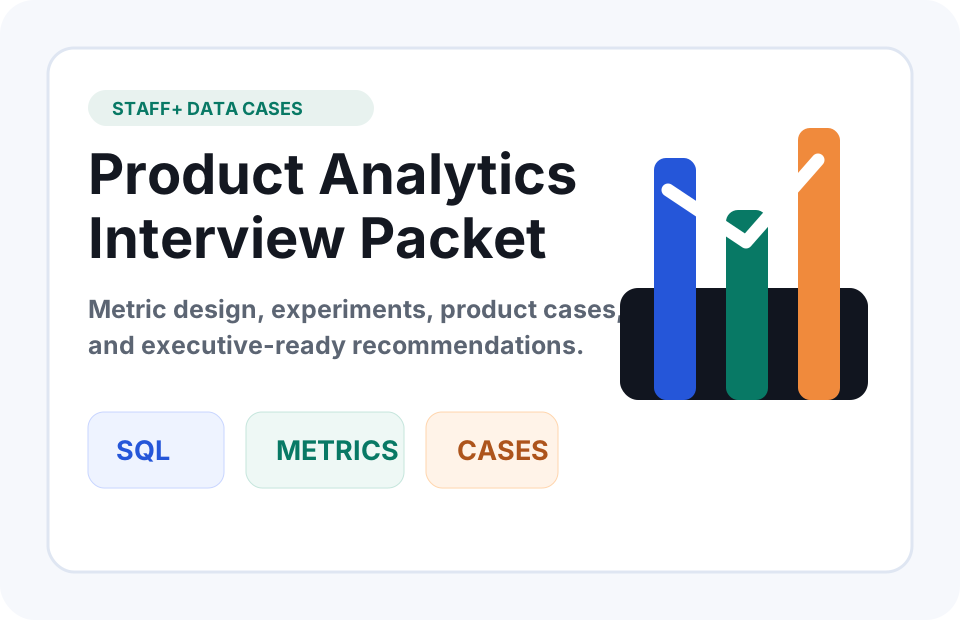
  • Choose Product Analytics if your loop includes SQL/OA follow-ups, metrics, experimentation, product sense, dashboards, causal reasoning, marketplace cases, or business recommendations.
  • Choose Leadership Behavioral if your loop includes conflict, failure, stakeholder influence, ambiguity, executive communication, team leadership, or final-round story pressure.
  • Use both if your loop includes product cases plus hiring-manager, cross-functional, or executive-stakeholder rounds.

Pick the round most likely to cost you the offer.

Start with the packet that matches your next interview. Use both if your loop includes product cases plus leadership or stakeholder rounds.

Both
Suggested sprint

Most senior loops test both muscles

Buy the product analytics packet if your next round is a case. Add the leadership packet if your loop includes behavioral, hiring-manager, cross-functional, or executive-stakeholder interviews.

  • Run 5 product mocks
  • Build 6 leadership stories
  • Score every answer
  • Rewrite weak answers with your own facts
$59 each
Direct checkout with instant file delivery.

Sample prompts inside

  • Your AI assistant product has high trial usage but weak repeat usage. What metrics do you inspect first?
  • An experiment is flat overall but positive for enterprise users. What do you recommend?
  • Tell me about a time you changed a senior stakeholder's mind with data.
  • Describe a failure where your analysis was technically right but operationally ineffective.

This is for candidates who know the basics

The harder part is sounding clear under pressure: structuring ambiguous answers, naming the tradeoff, and proving decision ownership instead of just analytical skill.

How to use the packet this week

  • Pick one prompt that matches your next round.
  • Answer out loud before reading the worked answer.
  • Ask your assistant to challenge weak assumptions and push for specifics.
  • Rewrite the answer using your own projects, metrics, and tradeoffs.
  • Repeat until your opener states the decision, the risk, and the recommendation.

What to keep private

  • Do not upload confidential employer docs, customer data, internal dashboards, or unreleased strategy unless you have permission.
  • Replace employer names with generic context such as consumer marketplace, AI assistant platform, or enterprise SaaS product.
  • Round exact metrics and remove personal names.
  • Practice truthful stories. The system helps package experience, not invent it.

Pick the packet that matches your next round.

Use product analytics for metrics, experiments, and cases. Use leadership when the loop asks for influence, conflict, failure, or executive communication.

Start product analytics prep

Public checkout is for self-guided packet buyers.

If a coaching, mock-interview, or private session already gave you packet access, use that private access and do not buy the same packet again. The public $59 checkout is for candidates buying the self-guided Product Analytics or Leadership packet directly.

Use Product Analytics for SQL, metrics, experiments, and product cases. Use Leadership for conflict, failure, ambiguity, influence, and final-round stories.

Run one timed rep before checkout.

Pick the risk you can fix today. Do the rep, then buy the packet only if it matches the round in front of you.

  • SQL or OA: say the row grain first, solve one baseline query, then name the edge case that could break it.
  • Product case: start with the decision, then give the metric view, segment, risk, and recommendation.
  • Leadership loop: choose one conflict, failure, or ambiguity story and name the operating change you owned.

Last-mile check: pick the packet for the round you could lose.

Use the rep on this page first. If the weak spot is SQL, metrics, experiments, or product cases, get Product Analytics. If the weak spot is conflict, ambiguity, or final-round stories, get Leadership. Public checkout is $59 and separate from any private session access.